Broiler Chicks Price in Pakistan: Live One Day Old (DOC) Rates
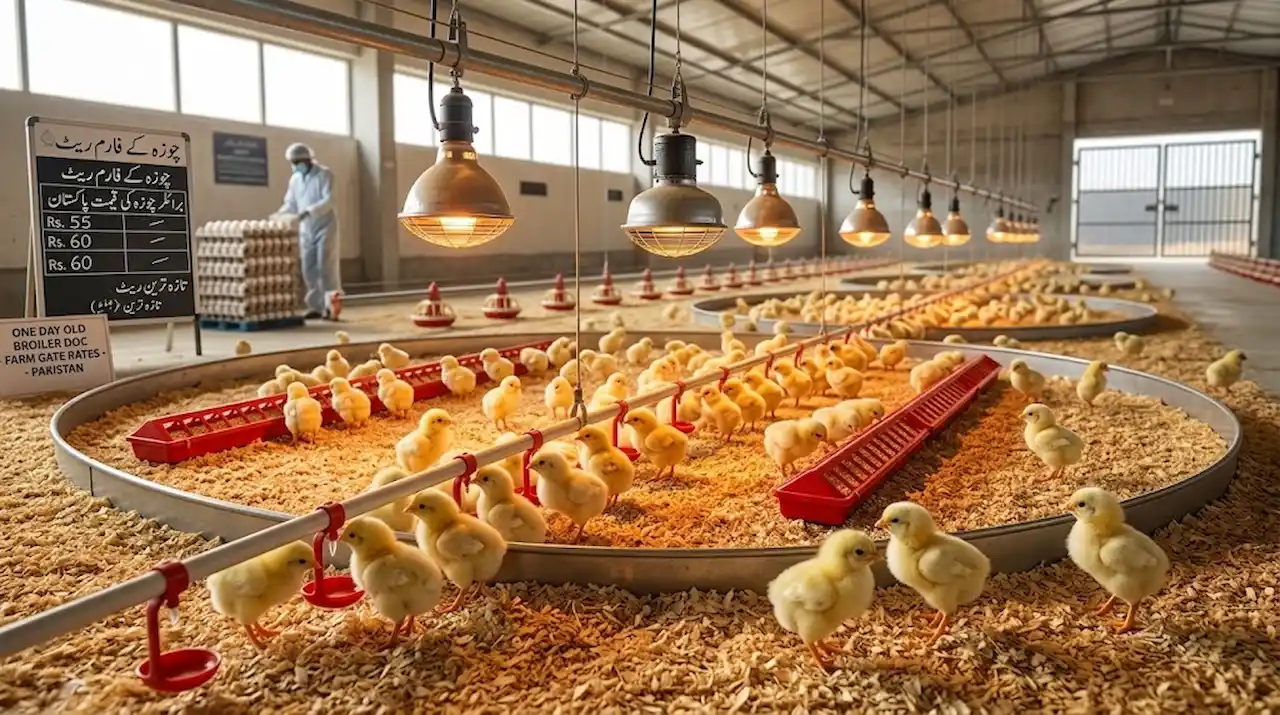
The official announced broiler chicks price in Pakistan today ranges from Rs. 88.00 to Rs. 94.00 per chick at the farm gate and wholesale hatchery delivery points. Rates vary across Punjab, Sindh, and KP depending on feed costs, hatchery hatch cycles, seasonal weather demand, and parent stock availability.
Starting or restocking a commercial poultry shed requires staying constantly updated on the broiler chicks price in Pakistan today. One-day-old chicks (commonly known as Day-Old Chicks or DOC / Broiler Chuza) are the fundamental cost driver of any poultry farming enterprise. Because day-old chicks have a narrow transit survival window, their spot market rate updates on a daily basis across Pakistan’s major poultry hubs including Lahore, Rawalpindi, Faisalabad, and Karachi.
Below is the detailed city-wise price breakdown, popular commercial breed comparisons (Cobb 500, Ross 308, Hubbard), and key factors dictating daily poultry market fluctuations.
City-Wise One Day Old Broiler Chicks Rates Today
Hatchery associations (such as PPA – Pakistan Poultry Association) announce benchmark rates daily, but city delivery points reflect slight variations due to inter-city air-conditioned van logistics and regional shed capacity:
| City / Market Hub | Announced Farm Rate | Vaccinated Rate | Standard Box (100 DOC) | Market Status |
|---|---|---|---|---|
| Lahore | Rs. 90.00 – 92.00 | Rs. 95.00 – 98.00 | Rs. 9,000 – 9,200 | Active / Stable |
| Rawalpindi / Islamabad | Rs. 89.00 – 92.00 | Rs. 94.50 – 97.50 | Rs. 8,900 – 9,200 | High Demand |
| Faisalabad | Rs. 89.50 – 92.00 | Rs. 95.00 – 98.00 | Rs. 8,950 – 9,200 | Stable |
| Multan | Rs. 91.00 – 93.50 | Rs. 96.00 – 99.00 | Rs. 9,100 – 9,350 | Normal Supply |
| Karachi | Rs. 92.50 – 96.00 | Rs. 97.50 – 100.50 | Rs. 9,250 – 9,600 | Steady Movement |
| Gujranwala | Rs. 90.00 – 92.00 | Rs. 95.00 – 98.00 | Rs. 9,000 – 9,200 | Active |
| Peshawar | Rs. 92.00 – 94.50 | Rs. 96.50 – 99.50 | Rs. 9,200 – 9,450 | Moderate Demand |
| Rahim Yar Khan | Rs. 91.00 – 93.00 | Rs. 95.50 – 98.50 | Rs. 9,100 – 9,300 | Normal Supply |
Commercial Broiler Breeds: Rates & Performance Comparison
Pakistani poultry farmers primarily choose between three globally recognized genetic lines. Each breed offers distinct advantages depending on whether your farm setup is environmentally controlled (EC shed) or open-sided:
| Breed Name | Avg. Price / Chick | Harvest Age | Target Weight (35 Days) | Best Farm Environment |
|---|---|---|---|---|
| Cobb 500 | Rs. 91.00 – 95.00 | 33 – 38 Days | 1.9 – 2.2 kg | Environmentally controlled (EC) sheds |
| Ross 308 | Rs. 90.00 – 93.50 | 35 – 40 Days | 2.0 – 2.3 kg | Excellent overall feed conversion ratio (FCR) |
| Hubbard Classic | Rs. 89.00 – 92.00 | 38 – 42 Days | 1.8 – 2.1 kg | Hardy, resilient in semi-controlled & open sheds |
| Golden Misri (Desi Cross) | Rs. 45 – 65 | 70 – 85 Days | 1.1 – 1.3 kg | Rural backyard & desi organic farming |
Why Broiler Chick Rates Fluctuate Daily in Pakistan
Unlike manufactured goods with fixed retail prices, day-old chick rates are governed by rapid dynamic cycles:
- Hatchery Egg Setting Cycles: Grandparent and parent stock flocks follow strict laying curves. When hatcheries face lower hatchability rates or egg setting shortfalls, chick supply tightens immediately, pushing spot prices upward.
- Poultry Feed Pricing (Corn & Soybean): Feed constitutes approximately 70% of total broiler production expenses. When imported soybean meal or local corn prices increase, farmers adjust their placement schedules, directly altering chick demand.
- Live Broiler Meat Market Linkage: If the mandi rate for live broiler chicken rises above Rs. 320–340/kg, farmers rush to restock their sheds to capture upcoming profits, triggering sharp demand spikes for day-old chicks.
- Seasonal Weather Stress: During peak summer heat waves, high mortality risks discourage farmers from filling sheds, softening chick prices. Conversely, moderate spring and autumn temperatures encourage maximum shed occupancy.
Broiler Chicks vs. Layer Chicks: Key Differences
Before purchasing day-old stock, ensure you are buying the correct genetic line for your production objectives:
| Feature | Commercial Broiler Chick | Commercial Layer Chick |
|---|---|---|
| Primary Objective | Meat Production (Rapid Muscle Gain) | Commercial Table Egg Production |
| Rearing Duration | 35 to 40 Days | 72 to 80 Weeks |
| Average Chick Cost | Rs. 88.00 – 95.00 | Rs. 130 – 165 |
| Market Rate Volatility | High (Changes Daily) | Low (Changes Weekly / Seasonally) |
Essential Checklist Before Receiving Chicks at Your Shed
To maximize flock livability and protect your investment during the critical first 7 days of brooding:
- Verify Vaccination Status: Always demand proof of hatchery spray vaccination for Newcastle Disease (ND) and Infectious Bronchitis (IB). A pre-vaccinated batch costs Rs. 2–4 extra per chick but prevents catastrophic early mortality.
- Uniform Weight Inspection: High-grade DOCs should weigh between 38g and 44g with a clean, dry, well-healed navel and bright, alert eyes. Avoid lethargic chicks or those with unabsorbed yolk sacs.
- Brooding Hall Temperature: Pre-heat your brooding area 24 hours prior to chick arrival. Ensure the litter bedding reaches 32°C to 34°C with fresh chick paper and electrolyte water ready for immediate hydration.
- Count and Mortality Buffer: Standard hatchery packing boxes contain 100 chicks plus an extra 2 chicks (102 total) to offset potential in-transit mortality.
The 5-Point Hatchery Quality Test: How to Inspect A-Grade Day-Old Chicks (DOC)
In Pakistan’s commercial poultry sector, early chick mortality during the first week (often called “first-week brooding loss”) is overwhelmingly determined by hatchery hygiene and the physical health of incoming day-old chicks. Before signing the delivery challan from a hatchery van (Big Bird, Jadeed, Hi-Tech, or SB), shed supervisors should randomly sample 20 chicks per box and perform these five physical quality checks:
| Inspection Parameter | A-Grade Healthy Chick Standard | B-Grade / Defective Warning Sign | Veterinary & Financial Risk |
|---|---|---|---|
| Navel (Naf) Condition | Clean, fully closed, dry, and free of dried yolk clots | Black buttons, unclosed moist cord, or protruding yolk sac | Causes Omphalitis (navel infection) and E. coli septicemia; mortality spikes on Days 3–5. |
| Reflex & Alertness (The Flip Test) | Chick placed on its back rights itself immediately within 3 seconds | Sluggish, struggles on back longer than 5 seconds or lies motionless | Indicates incubator dehydration, overheating during transit, or congenital weakness. |
| Shank & Hock Hydration | Plump, smooth, bright yellow legs with soft skin | Dry, wrinkled skin with visible veins; red swollen hock joints | Over-incubated chicks. Red hocks indicate difficulty kicking out of the eggshell. |
| Vent Cleanliness | Completely clean vent feathers with zero sticky droppings | Pasted vent with chalky white urates or brownish diarrhea | Sign of Salmonella or chilling during transit. Requires aggressive immediate antibiotic therapy. |
| Weight Uniformity | Standard 38g to 44g per chick with low standard deviation | Mixed weights (under 32g mixed with heavy 48g chicks) | Uneven growth curve. Smaller birds get bullied at feed pans, causing 15% lower final weight. |
Broiler Production Economics: From Day-Old Chick to 2.0 KG Market Bird
Profitable poultry farming depends on understanding the true cost of production per kilogram of live chicken meat. Many new farmers make the mistake of looking only at the chick purchase rate. In reality, the day-old chick represents approximately 15% to 22% of your total cost of production, while poultry feed represents nearly 65% to 70%.
The table below illustrates an average cost-of-production breakdown for rearing a 2.0 kg live bird over a 32-to-35-day cycle in an environmentally controlled (EC) shed:
| Cost Head (Per Bird) | Consumption / Quantity | Average Cost (PKR) | Economic Role in Total Cost |
|---|---|---|---|
| Day-Old Chick (DOC) | 1 Chick (A-Grade) | Rs. 60 – Rs. 85 | Fluctuates daily based on seasonal demand and breeding flock supply. |
| Commercial Broiler Feed | 3.1 kg to 3.3 kg (FCR ~1.55) | Rs. 420 – Rs. 465 | Starter, Grower & Finisher rations (dependent on corn & soybean meal feed rates). |
| Vaccines & Veterinary Medicines | ND, IB, IBD (Gumboro) + Vitamins | Rs. 25 – Rs. 35 | Essential bio-security protocol to maintain under 4% flock mortality. |
| Bedding Litter (Rice Husk / Toori) | 3-inch bedding depth | Rs. 8 – Rs. 12 | Sourced from local grain markets (track toori rates and rice mills). |
| Heating & Electricity (Brooding) | LPG / Biomass heat + Ventilation fans | Rs. 20 – Rs. 35 | Significantly higher in December–January winter brooding months. |
| Total Production Cost (Per 2kg Bird) | 35-Day Cycle | Rs. 550 – Rs. 640 | Translates to Rs. 275 – Rs. 320 per kg farm-gate breakeven. Compare with current live broiler rates. |
Critical First-72-Hours Brooding Protocol for New Flocks
More than 50% of total flock culls occur during the first 72 hours of chick placement. Successful commercial farmers adhere to this strict chronological protocol:
- Pre-Heat the Shed 24 Hours in Advance: Never introduce day-old chicks into a cold shed. The concrete floor and litter must reach a stable temperature of 32°C to 34°C before chicks are tipped from their boxes. Cold litter causes rapid hypothermia, leading to yolk sac retention.
- The Glucose & Electrolyte Flush: During transport, chicks lose up to 1.5 grams of moisture per hour. Offer lukewarm water (22°C–25°C) enriched with 4% to 5% glucose and electrolytes for the first 2 hours before offering feed. This rehydrates their internal organs and stimulates digestive enzyme secretion.
- Paper Brooding for Feed Accessibility: Cover at least 50% of the brooding area floor with clean kraft paper and sprinkle fine starter crumbles generously. A chick’s natural foraging instinct will guide it to eat within 90 minutes of arrival.
- The Crop Fill Test (24 Hours Check): Check the crops of 100 randomly caught chicks 24 hours after placement. If your brooding environment is correct, at least 95% of chicks must have soft, pliable crops full of feed and water. If crops are hard and dry, water supply is insufficient; if crops are empty, room temperature is too cold or light intensity is too dim.
Related Poultry & Agriculture Rate Guides
Keep track of live livestock, poultry feed, and farm equipment rates across Pakistan:
- Today Chicken Rate in Pakistan (Live Broiler & Farm Gate Mandi Prices)
- Egg Price in Pakistan Today (Farm Egg & Desi Egg Dozen Rates)
- Chicken Meat Rate in Pakistan Today (Murghi ka Gosht Per KG Price)
- Broiler Rate in Pakistan Today (City-Wise Live Mandi Prices)
FAQs
What is the announced broiler chicks price in Pakistan today?
Today’s official announced market rate for a day-old broiler chick (DOC) in Pakistan ranges from Rs. 88.00 to Rs. 94.00 per chick at the farm gate in major poultry hubs like Lahore, Multan, and Rawalpindi. Vaccinated A-grade batches retail between Rs. 95.00 and Rs. 99.00.
How many chicks are packed in one standard hatchery box?
Commercial hatcheries in Pakistan pack day-old chicks in ventilated cardboard boxes containing 100 chicks, usually with 2 extra chicks (102 chicks total) added as a buffer against transit stress and mortality.
Which broiler chick breed is best for Pakistani weather?
Cobb 500 is the leading choice for environmentally controlled (EC) sheds due to fast weight gain and heavy breast meat yield. For semi-controlled and open sheds, Ross 308 and Hubbard Classic perform better because of higher heat and disease resistance.
Why do broiler chick rates change daily in Pakistan?
Broiler chick rates change daily based on live chicken meat mandi prices, commercial poultry feed costs (soybean and maize), seasonal brooding demand, and the current hatching output of parent stock flocks.
Do vaccinated day-old chicks cost more?
Yes. Hatcheries charge an extra Rs. 2.00 to Rs. 4.00 per chick for automated spray vaccination against Newcastle Disease (ND) and Infectious Bronchitis (IB). Buying pre-vaccinated chicks significantly reduces early flock mortality.