
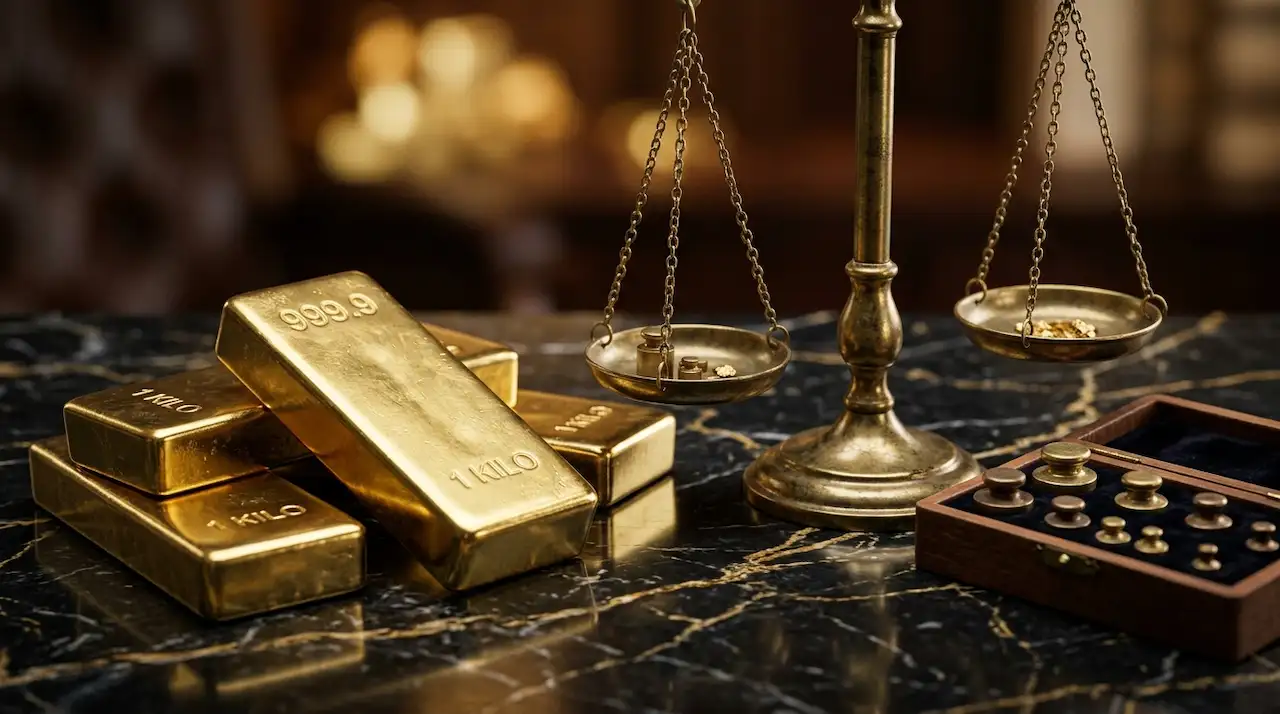
Gold has always held a sacred economic and cultural status in Pakistan. Beyond being a cherished ornament for weddings and festive traditions, physical gold serves as the nation’s foremost hedge against currency devaluation and persistent inflation. Yet, for millions of citizens who check the gold price in Pakistan every single morning, a fundamental question remains shrouded in mystery: How exactly is the daily gold rate determined, and who sets it?
Unlike standard consumer commodities whose price tags change weekly or monthly through government notifications, gold is a globally liquid asset that fluctuates minute-by-minute across international stock exchanges. In Pakistan, the final price consumers see in local Sarafa bazaars is the culmination of global trading, local currency fluctuations, import duties, and trade association benchmarks. In this comprehensive guide, we unpack the complete mathematical and economic mechanism behind Pakistan’s daily gold pricing.
1. The Primary Pillar: London Bullion Market (LBMA International Spot Price)
The journey of every gram of gold traded in Karachi, Lahore, Peshawar, or Quetta begins on international bullion exchanges—primarily the London Bullion Market Association (LBMA) and the COMEX (New York Mercantile Exchange).
On these international trading platforms, gold is not measured in grams or tolas. Instead, it is priced in Troy Ounces denominated in US Dollars (USD).
- 1 Troy Ounce = Exactly 31.1034768 grams (Note: This is different from a standard kitchen ounce, which weighs 28.3495 grams).
- Global institutional buyers, sovereign wealth funds, and central banks trade 24-karat bullion bars (99.99% purity) on these spot exchanges 24 hours a day during global market sessions.
Whenever geopolitical tensions flare up, interest rates shift in the United States, or global stock markets experience turbulence, international investors flock to physical gold as a safe-haven asset, driving global spot prices higher. This international dollar baseline serves as the raw ingredient for Pakistan’s domestic gold market.
2. The Currency Factor: USD to PKR Exchange Rate Parity
Because Pakistan does not possess large-scale commercial gold mining operations, virtually all gold circulating within the country has either been legally imported, brought in through expatriate passenger allowances, or recycled through private local holdings. Consequently, gold inside Pakistan is an imported asset priced entirely on dollar replacement value.
This creates a double-layered price mechanism. Even if the international price of gold remains completely flat in London, a depreciation in the value of the Pakistani Rupee (PKR) against the US Dollar (check live dollar rate in Pakistan) will immediately cause domestic gold prices to surge.
The mathematical conversion formula used by professional bullion traders looks like this:
Raw Bullion Rate (PKR / Gram) = [International Spot Price per Ounce in USD ÷ 31.1035] × Prevailing Interbank/Open Market USD-PKR Exchange Rate
3. Unit Conversion: From Troy Ounces to Tolas and 10 Grams
In Pakistan and the broader South Asian subcontinent, the public does not trade gold using ounces. Retail consumers and wholesale jewellers rely upon the traditional metric system established during the British-Indian era:
| Subcontinental Gold Unit | Metric Equivalent (Grams) | Common Usage in Pakistan |
|---|---|---|
| 1 Tola | 11.6638 Grams | Standard benchmark for bridal sets, retail coins, and Sarafa trading |
| 10 Grams | 10.0000 Grams | Modern commercial benchmark used by corporate bullion traders and banks |
| 1 Masha | 0.972 Grams (1/12th of a tola) | Used by goldsmiths for measuring small stones and minor alloy adjustments |
| 1 Ratti | 0.1215 Grams (1/96th of a tola) | Historical precision weight for precious gemstones and fine filigree work |
To convert the per-gram rupee cost into a single tola rate, market analysts multiply the raw gram price by 11.6638.
4. Who Actually Announces the Rate? The Role of the Sarafa Association
While individuals can calculate mathematical parity theoretically, local trading across Pakistan’s physical bazaars requires an authoritative, binding benchmark. This is where the All Pakistan Gems and Jewellers Sarafa Association (APGJSA) comes into play.
The apex committee of the Sarafa Association meets daily around noon (typically releasing official rates between 12:30 PM and 2:30 PM Pakistan Standard Time). The central rate is formulated by senior bullion merchants located in Karachi’s historic Sarafa Bazaar (the financial capital’s primary bullion exchange hub).
During their daily rate determination session, the association factors in:
- The Live Spot Price: Real-time international market feeds from London/Dubai.
- Currency Replacement Cost: The physical cash availability of US Dollars in Pakistan’s open and interbank markets.
- Local Supply and Demand Dynamics: Seasonal surges during peak wedding seasons (Shadi season) or agricultural harvest periods when farmers invest profits in bullion.
- The “Pakistan Premium” or “Discount”: Because direct commercial gold import quotas through normal banking channels can face regulatory restrictions, physical bullion supply in local vaults can either trade at a slight premium or discount compared to theoretical paper parity.
Once the central Karachi rate is issued, regional associations in Lahore, Islamabad, Rawalpindi, Peshawar, Multan, and Quetta adopt the rate, occasionally applying minor regional transport and logistics adjustments (often varying by a negligible Rs. 100 to Rs. 300 per tola).
5. Karat Purities: 24K vs 22K vs 21K vs 18K Explained
A frequent point of confusion among buyers is why their purchased necklace or bangle costs significantly less or more than the daily newspaper rate. The answer lies in karat purity:
- 24 Karat (99.9% Pure): 24K represents pure elemental gold. Because pure gold is extremely soft and malleable, it cannot retain intricate jewellery designs without bending. 24K is almost exclusively sold in the form of raw bullion bars, biscuits, and investment coins (Rawa gold).
- 22 Karat (91.6% Pure): This is the golden standard for traditional Pakistani bridal jewellery. To make gold durable enough to hold stone settings and delicate filigree, jewellers mix 22 parts gold with 2 parts copper, silver, or zinc (an alloy ratio of 91.6% purity). The 22K rate is calculated as: 24K Rate × (22 ÷ 24).
- 21 Karat (87.5% Pure): Popular in Arab countries and certain regional Pakistani bazaars for heavier, durable daily-wear bangles and chains.
- 18 Karat (75.0% Pure): Composed of 75% pure gold and 25% alloy metals. 18K is predominantly used in modern diamond jewellery and white-gold or rose-gold settings because its higher hardness holds precious stones securely.
6. The Hidden Retail Charges: Making Charges (Jarrat / Banawat) & Kanta Deductions
When you visit a local jewellery shop to purchase finished ornaments, the price you pay is rarely just the weight multiplied by the daily tola rate. Consumers must navigate two crucial retail variables:
A. Making Charges (Banawat / Mazdoori)
Making charges represent the craftsman’s fee for designing, casting, and polishing the jewellery piece. Depending on whether an ornament is machine-cast, handcrafted, or laser-cut, making charges in Pakistan range anywhere from Rs. 1,000 to over Rs. 3,500 per tola. Always ask the jeweller to provide a clear itemised receipt distinguishing between the pure gold weight and the making charges.
B. Stone Weight Deduction (Nagina / Kundan)
Traditional Pakistani bridal pieces feature synthetic stones, pearls, and glass beads (Kundan / Zircon). A reputable jeweller must always weigh the base gold frame separately before embedding stones, or deduct the gross stone weight from the final bill. Never pay the full gold rate for non-precious decorative stones!
7. Essential Checklist: 4 Golden Rules for Consumers in Pakistan
Before purchasing or liquidating gold in any Pakistani market, adhere strictly to these consumer protection standards:
- Check the Live Daily Ticker First: Always review verified daily Sarafa rates on independent tracking portals like CheckPrice.pk Today Gold Rate (or verify daily silver rates) before stepping into the bazaar. Having the exact morning and afternoon benchmark prevents unfair markups.
- Insist on Electronic Karat Testing: Ask your jeweller to test the purity of the piece using an electronic XRF (X-Ray Fluorescence) analyzer. High-end Sarafa markets in Karachi (Zebunnisa Street), Lahore (Suhawa / Anarkali), and Rawalpindi offer third-party computerized testing laboratories for a nominal fee.
- Obtain a Computerized Printed Invoice: An official tax invoice detailing gross weight, net gold weight, purity karat, making charges, and the jeweller’s NTN registration ensures full liquidity if you choose to resell the item in the future.
- Understand Resale Deduction Policies: In Pakistan, when you resell jewellery back to the shop, reputable jewellers typically deduct only the making charges and stone weight, refunding 100% of the active bullion melt value according to that day’s live market rate.
Final Verdict
Understanding how the Sarafa Association determines daily gold rates demystifies one of Pakistan’s most valuable financial markets. By tracking international LBMA movements, monitoring the USD-PKR exchange rate, and knowing the exact purity ratios between 24K and 22K gold, Pakistani investors and families can make informed, wealth-preserving decisions without falling prey to arbitrary retail markups.


One Comment