
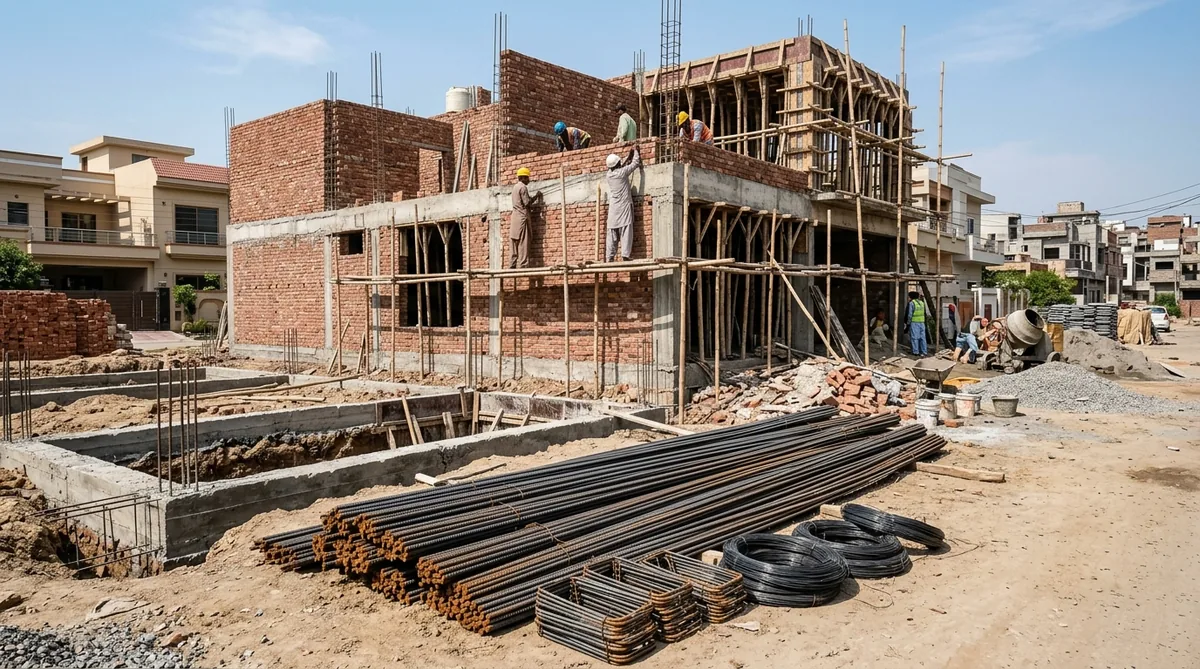
How Much Saria (Steel) Do You Need for House Construction?
A verified civil engineering guide to calculating steel rebar quantities for 3 Marla, 5 Marla, 10 Marla, and 1 Kanal residential homes in Pakistan — featuring field-accurate per sq ft formulas and Soot-to-MM conversions.
- Verified Thumb Rule: Standard residential homes in Pakistan consume 2.4 to 2.8 KG of steel per sq ft of covered area.
- 3 Marla Double Storey: Requires 4.0 to 4.8 Metric Tons (4,000–4,800 KG) of steel.
- 5 Marla Double Storey: Requires 4.8 to 5.5 Metric Tons (4,800–5,500 KG) of Grade 60 steel.
- 10 Marla Double Storey: Requires 9.5 to 12.0 Metric Tons (9,500–12,000 KG) of steel.
- Rebar Standard: Use certified Grade 60 (ASTM A615) deformed bars from primary mills (Mughal, Amreli, Ittefaq).
In Pakistani residential construction, steel rebar (saria) represents approximately 20% to 25% of your total grey structure material cost. A standard 3 Marla double-storey house requires 4.0 to 4.8 tons, a 5 Marla double-storey requires 4.8 to 5.5 tons, a 10 Marla double-storey demands 9.5 to 12 tons, and a 1 Kanal home takes 18 to 22 tons. Roof slabs consume the largest single share (35% to 40%), followed by plinth beams and foundations (25% to 30%).
Steel rebar, universally known as Saria across Pakistan, provides essential tensile resistance for reinforced cement concrete (RCC). Concrete handles immense downward compression, but it cannot withstand bending stresses or earthquake shaking without steel reinforcement embedded inside.
Estimating steel rebar accurately protects you from two costly mistakes. Underestimating halts your roof slab casting midway through the pour, while overestimating leaves expensive steel bundles rusting under monsoon rain on an open plot.
This technical guide details the exact per square foot formulas, plot-by-plot steel charts, traditional Soot-to-MM conversions, and practical buying tips tested across real Pakistani building sites.
1. The Civil Engineering Thumb Rule: Calculating Steel Per Square Foot
In Pakistan, structural engineers evaluate steel consumption based on the structural framing type and total covered area:
- Standard Residential Double Storey: 2.4 to 2.8 KG per sq ft (average: 2.6 KG/sq ft).
- Single Storey Brick Construction: 2.0 to 2.4 KG per sq ft.
- Commercial / Full RCC Frame (No Load-Bearing Brickwork): 3.5 to 4.2 KG per sq ft.
Practical Example: A double-storey 5 Marla house typically features approximately 2,000 square feet of total covered area (1,050 sq ft ground floor + 950 sq ft first floor).
Using the verified baseline of 2.6 KG per sq ft:
2,000 sq ft × 2.6 KG = 5,200 KG (5.2 Metric Tons).
This perfectly aligns with the standard 4.8 to 5.5 ton procurement bracket observed on residential sites in Lahore, Rawalpindi, and Karachi.
2. House Size vs. Steel Quantity Comparison Table
The table below summarizes total Grade 60 steel rebar requirements and approximate budget outlays for standard residential structures:
Note: Budget figures reflect prevailing Grade 60 mill rates of Rs. 255 to Rs. 262 per KG. For complete house budget breakdowns, explore our 5 Marla House Construction Cost Breakdown.
3. Understanding Pakistani Rebar Sizes: The “Soot” to Millimeter Conversion Guide
In Pakistan, steel rebar is measured and traded in an imperial unit called “Soot” (سوتر). One Soot represents one-eighth of an inch (1/8″ or ~3.175 mm). Understanding this conversion ensures you order the exact diameter specified on your structural drawings:
4. Structural Breakdown: Where Does the Steel Actually Go?
To verify material demands against your contractor’s bills, review how steel rebar is distributed across the different components of your home:
- Roof Slabs (RCC Chatt) — 35% to 40%: The largest steel allocation occurs during slab casting. Slabs feature double-grid mesh reinforcement of 3 Soot and 4 Soot bars spaced at 6-inch to 8-inch centers. Combine this with certified Ordinary Portland Cement (PS:232) from our Top Pakistan Cement Brand Guide for solid crack resistance.
- Foundations & Plinth Beams — 25% to 30%: Raft footings, isolated column pads, and underground tie-beams require 4 Soot and 5 Soot bars to resist ground shifts.
- RCC Columns (Pillars) — 15% to 20%: Vertical columns support structural loads across floors. Standard columns feature 4 to 8 vertical 5 Soot bars bound by 3 Soot stirrups spaced 6 to 8 inches apart.
- Beams, Lintels & Staircases — 15% to 20%: Door/window lintels, inverted floor beams, and waist-slabs for staircases consume the remaining steel supply.
5. Grade 60 vs. Grade 40 vs. Local Re-Rolled Steel
Choosing between steel grades has profound consequences for structural safety and construction economics. Here is how the three available steel types compare in Pakistan:
✅ Certified Grade 60 Deformed Rebar
- Standard: ASTM A615 / BS 4449 compliant from primary mills (Mughal, Amreli, Ittefaq, Kamran).
- Yield Strength: 60,000 PSI with 9% to 12% elongation for earthquake resilience.
- Surface Ribs: Deeply embossed mechanical ribs bond permanently with concrete.
- Best For: Modern double-storey houses, roof slabs, and multi-storey columns.
ℹ️ Standard Grade 40 Deformed Steel
- Standard: ASTM A615 Grade 40 standard with 40,000 PSI minimum yield strength.
- Ductility: Highly malleable and easy to bend without stress fractures.
- Design Requirement: Demands 25% to 30% more total steel volume to match Grade 60 load capacity.
- Best For: Single-storey homes, boundary walls, and non-critical lintels.
❌ Local Re-Rolled Scrap Steel (Gaddi)
- Source: Melted scrap metal, ship-breaking plates, and rejected railway lines.
- High Brittleness: Uncontrolled carbon causes bars to snap suddenly when bent at 90°.
- Uneven Diameter: Bar diameter fluctuates significantly, creating weak shear points.
- Risk: Catastrophic sudden collapse under earthquake loads. Avoid completely.
6. Practical Buying & On-Site Checklist for Homeowners
Follow these four mandatory procurement precautions when purchasing steel in Pakistan to avoid being shortchanged by dealers:
- Weigh on a Certified Computerized Weighbridge (Kanda): Never rely on local retail manual scales. Drive the loaded delivery truck directly to an independent computerized weighbridge (kanda) before unloading, and weigh the empty truck on your return to verify net weight.
- Surface Rust vs. Pitted Rust: Fresh steel develops a light reddish-brown surface powder within days due to humidity. This light surface oxidation is harmless and actually improves concrete adhesion. However, reject bars that exhibit deep dark pits, scaling, or flaking rust, as cross-sectional diameter has been lost.
- Lapping Length Allowance (45D Rule): Structural bars must overlap where one bar ends and the next begins. The universal overlap thumb rule is 45 to 50 times the diameter of the bar (45D to 50D). For a 12mm (4 Soot) bar, lapping requires 21 to 24 inches of overlap. Always factor in 4% to 5% extra steel to account for lapping.
- Binding Wire (Taar) Requirement: Masons use 20-gauge galvanized binding wire to tie intersecting bars securely before concrete pouring. Budget approximately 10 to 12 KG of binding wire per 1 Metric Ton of steel.
Ensure column and beam splices are staggered rather than grouped at the same level. For cantilever car porches and balconies, verify that the main tension steel is anchored into the adjoining internal floor slab by at least 1.5 times the cantilever length.
Frequently Asked Questions (FAQs)
How much saria (steel) is needed for a 5 Marla double-storey house in Pakistan?
A standard double-storey 5 Marla house with 1,900 to 2,100 square feet of covered area requires approximately 4.8 to 5.5 metric tons (4,800 to 5,500 KG) of Grade 60 steel rebar. This translates to an average consumption of 2.5 to 2.75 KG per square foot for typical residential load-bearing brick construction.
What is the civil engineering thumb rule for steel calculation per square foot in Pakistan?
In Pakistani residential construction, the verified structural thumb rule is 2.4 to 2.8 kilograms of steel per square foot of covered area for standard double-storey brick-framed houses. For heavy commercial frame structures with no load-bearing brickwork, this requirement increases to 3.5 to 4.2 kg per sq ft.
Grade 60 vs Grade 40 steel: Which is better for house construction?
Grade 60 (ASTM A615) deformed steel is the industry standard for residential construction in Pakistan. With a minimum yield strength of 60,000 PSI, it provides superior earthquake resilience and requires fewer bars than Grade 40 (40,000 PSI), resulting in lower overall project costs and less steel congestion in beams.
What does ‘Soot’ mean in Pakistani steel rebar measurement?
‘Soot’ is an imperial measurement unit universally used in Pakistani iron markets representing one-eighth of an inch (1/8 inch or 3.175 mm). For instance, 3 Soot equals roughly 10mm, 4 Soot equals 12mm, and 5 Soot corresponds to 16mm rebar.
How much binding wire (taar) is needed per ton of steel?
You will need approximately 10 to 12 kilograms of 20-gauge galvanized binding wire for every 1 metric ton (1,000 KG) of steel rebar. For a 5 Marla double-storey home requiring 5 tons of steel, budget for 50 to 60 kg of binding wire.