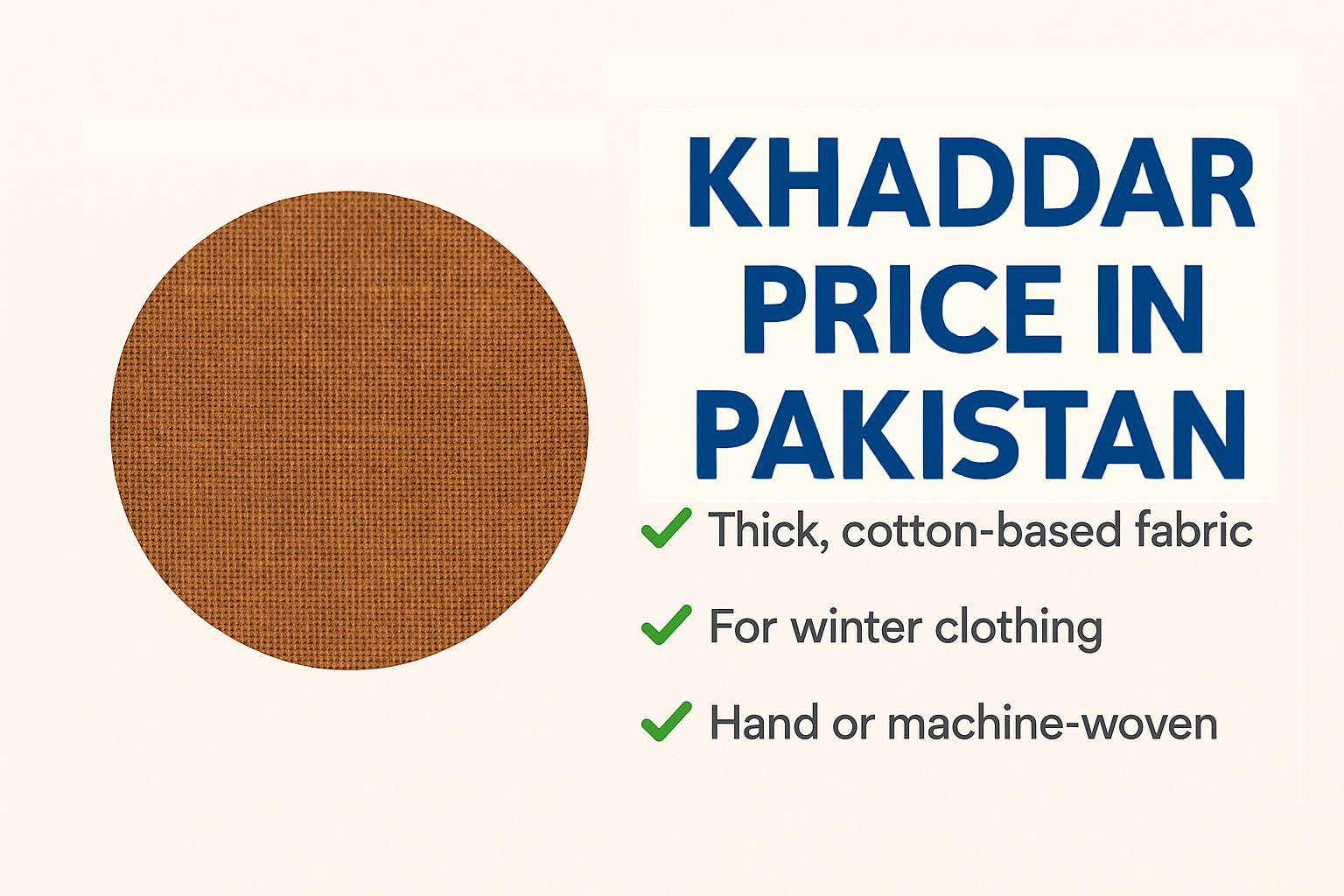
When winter fog rolls across Punjab and northern Pakistan from November through February, Khaddar (کھدر) becomes the undisputed staple of Pakistani wardrobes. Whether you are shopping for a rugged men’s plain Kamalia khaddar suit at Azam Cloth Market in Lahore, or browsing digitally printed 3-piece winter unstitched collections from Khaadi, Sapphire, and Gul Ahmed, prices vary dramatically depending on cotton yarn count, weaving method, and dye fastness.
In 2026, a standard 4.5-meter men’s unstitched khaddar suit in Pakistan costs between Rs. 1,850 and Rs. 6,500, while women’s 3-piece printed and embroidered winter khaddar suits range from Rs. 2,800 to Rs. 9,500. Below is the complete, updated market rate breakdown across wholesale textile hubs and retail brands.
Updated Khaddar Price in Pakistan (2026 Winter Market Rates)
Textile wholesale rates in Faisalabad’s Karkhana Bazar and Kamalia’s weaving clusters set the baseline for winter fabric prices across Pakistan. Here is what buyers are paying this season:
| Khaddar Category & Weaving Type | Standard Cutting | Wholesale / Mandi Rate (PKR) | Retail / Brand Price (PKR) |
|---|---|---|---|
| Kamalia Power-Loom Khaddar (Men’s Plain) | 4.5 Meters (Arz 54″) | Rs. 1,650 – Rs. 2,300 | Rs. 2,400 – Rs. 3,400 |
| Authentic Hand-Loom (Khaddi) Organic Khaddar | 4.5 to 5 Meters | Rs. 3,200 – Rs. 4,200 | Rs. 4,500 – Rs. 6,500 |
| Slub & Melange Textured Men’s Khaddar | 4.5 Meters | Rs. 2,200 – Rs. 2,900 | Rs. 3,200 – Rs. 4,800 |
| Women’s 2-Piece Digital Printed Khaddar | Shirt + Trouser (5m) | Rs. 1,750 – Rs. 2,200 | Rs. 2,600 – Rs. 3,900 |
| Women’s 3-Piece Printed Khaddar (With Shawl) | 7.5 to 8 Meters | Rs. 2,400 – Rs. 3,300 | Rs. 3,800 – Rs. 6,200 |
| Branded Heavy Embroidered Winter Khaddar | 3-Piece Unstitched | Rs. 3,800 – Rs. 5,200 | Rs. 6,500 – Rs. 11,500 |
| Plain Dyed Khaddar by the Meter (Loose Cut) | 1 Meter | Rs. 360 – Rs. 520 / m | Rs. 550 – Rs. 850 / m |
Kamalia Khaddar vs. Faisalabad Mill-Made Khaddar: What’s the Real Difference?
Walk into any cloth shop in Rawalpindi’s Raja Bazar, Karachi’s Bolton Market, or Multan’s Hussain Agahi, and every shopkeeper will claim their fabric is “Asli Kamalia Khaddar.” However, experienced textile buyers know there are three completely distinct grades sold under the khaddar name in Pakistan:
1. Traditional Hand-Loom (Khaddi) Khaddar
Woven manually on wooden pit looms in District Toba Tek Singh (specifically Kamalia) and parts of Jhang and Chiniot, genuine hand-spun or hand-woven khaddar uses slightly irregular, open-end cotton yarns. Because the shuttle is thrown by hand rather than high-speed air jets, the fabric has tiny natural air pockets between the warp and weft threads. It feels slightly coarse before its first wash, softens remarkably with every laundry cycle, and keeps the body warm in 5°C January nights while remaining breathable indoors.
2. Kamalia Power-Loom (Auto-Loom) Khaddar
Accounting for nearly 75% of men’s winter shalwar kameez sales in Pakistan, power-loom khaddar uses combed 20/20 or 16/16 count cotton yarn woven on motorized shuttleless looms. It delivers a much smoother, uniform fall without the loose knots (slubs) of hand-loom cloth, making it ideal for office wear and waistcoats. When finished with a warm mercerized or silicon wash, it drapes almost like heavy winter cotton.
3. Poly-Blended “Mix” Khaddar (Low-Budget Copy)
Sold between Rs. 1,200 and Rs. 1,600 per suit in Sunday bazaars and budget online stores, this fabric blends 30% to 50% polyester staple fiber with recycled cotton. While it looks shiny and wrinkle-free on the counter, poly-blended khaddar develops unsightly lint balls (burr/pilling) under the arms and around the collar within three weeks of wear.
Top Branded Khaddar Suit Prices in Pakistan (Winter 2026 Comparison)
If you prefer retail outlets over wholesale cloth markets, here is how Pakistan’s leading textile brands price their unstitched winter khaddar collections this year:
| Brand Name | Specialty | Men’s Unstitched (4.5m) | Women’s 3-Piece Range |
|---|---|---|---|
| Kamalia Khaddar (Official Outlets) | Pure cotton hand & power-loom men’s fabric | Rs. 2,650 – Rs. 4,500 | Rs. 3,100 – Rs. 4,800 |
| Gul Ahmed (Ideas) | Vintage Yarn-Dyed & Royal Slub Khaddar | Rs. 4,200 – Rs. 7,500 | Rs. 4,500 – Rs. 8,900 |
| Khaadi | Lightweight Air-Jet Printed Ladies Khaddar | N/A | Rs. 3,900 – Rs. 7,800 |
| Sapphire & Nishat Linen | Fine Combed Cotton Digital & Embroidered | Rs. 4,500 – Rs. 6,800 | Rs. 4,290 – Rs. 9,990 |
| J. (Junaid Jamshed) & Alkaram | Pre-Shrunk Blended & Pure Winter Khaddar | Rs. 4,800 – Rs. 7,900 | Rs. 4,600 – Rs. 9,500 |
Why Pure Khaddar Shrinks (And How to Pre-Shrink Before Stitching)
One of the biggest mistakes buyers make is handing a newly purchased khaddar suit directly to the tailor without soaking it first. Because pure cotton khaddar is woven with thick, loosely twisted two-ply yarns under high loom tension, the fibers relax and contract the moment they absorb water.
- Expected Shrinkage Margin: Authentic 100% cotton khaddar shrinks by 5% to 8% in length (roughly 6 to 9 inches across a 4.5-meter cutting). If your tailor stitches the kameez before soaking, the sleeves and hem will ride up noticeably after the very first laundry wash.
- Proper Pre-Wash Method: Unfold the entire unstitched suit and submerge it in a bucket of lukewarm water (never boiling water) for 2 to 3 hours. Do not add harsh detergent powder during the first soak; if it is a dark navy, black, or maroon shade, add two tablespoons of plain white salt to lock the reactive vat dye. Hang it in the shade to drip-dry, then press with a steam iron before taking it to your tailor.
Buyer’s Checklist: How to Test Pure Cotton vs. Polyester Mix in the Market
- The Thread Burn Test: Pull a single loose thread from the selvage (kani) edge of the fabric and light it with a match. Pure 100% cotton khaddar burns steadily with a smell like burning paper and leaves soft grey ash that crumbles between your fingers. If the thread melts into a hard, black plastic bead and smells like chemical smoke, it contains polyester.
- The Fist Crush Test: Grab a handful of the fabric and squeeze it tightly for five seconds. Pure cotton khaddar will hold a soft crease when you release your hand. If it springs back completely flat like elastic, it has synthetic mix yarn that will pill (burr) later.
- Check the Selvage Width (Bada Arz vs. Chota Arz): Standard power-loom khaddar comes in 54-inch width (Bada Arz), where 4.25 to 4.5 meters is plenty for an adult male suit. Traditional hand-loom khaddi fabric often comes in a narrower 36-inch width (Chota Arz), which requires 6.5 to 7 meters for a full shalwar kameez. Always verify the width before paying.
Related Lifestyle & Tailoring Guides on CheckPrice.pk
- 🧵 Silai Machine Price in Pakistan – Compare Juki, Singer, and Salika sewing machine rates for home tailoring.
- 🧺 Automatic Washing Machine Price in Pakistan – Best top-load and front-load machines for winter laundry.
- 🪙 Gold Price in Pakistan Today – Daily 24K and 22K Sarafa Bazar bullion updates.
What is the price of original Kamalia Khaddar in Pakistan in 2026?
An authentic 4.5-meter men’s Kamalia power-loom khaddar suit costs between Rs. 2,400 and Rs. 3,400 at official outlets, while traditional hand-woven (khaddi) organic Kamalia khaddar ranges from Rs. 4,200 to Rs. 6,500.
Why does khaddar develop lint balls (burr) after washing?
Pure 100% combed cotton khaddar does not develop permanent plastic lint balls. Pilling (burr) happens when manufacturers blend cheap polyester fibers with short-staple cotton. Always ask for 100% pure cotton yarn-dyed khaddar and wash inside-out in cold water.
How many meters of khaddar are needed for a men’s shalwar kameez?
In standard 54-inch width (Bada Arz), 4.25 to 4.5 meters is sufficient for a normal adult size, while tall or heavy builds require 4.75 to 5 meters (especially after accounting for 6% pre-wash shrinkage).
Which city is famous for the best wholesale khaddar in Pakistan?
Kamalia (in District Toba Tek Singh) and Faisalabad (Karkhana Bazar and Montgomery Bazar) are the two largest manufacturing and wholesale hubs for winter khaddar in Pakistan.