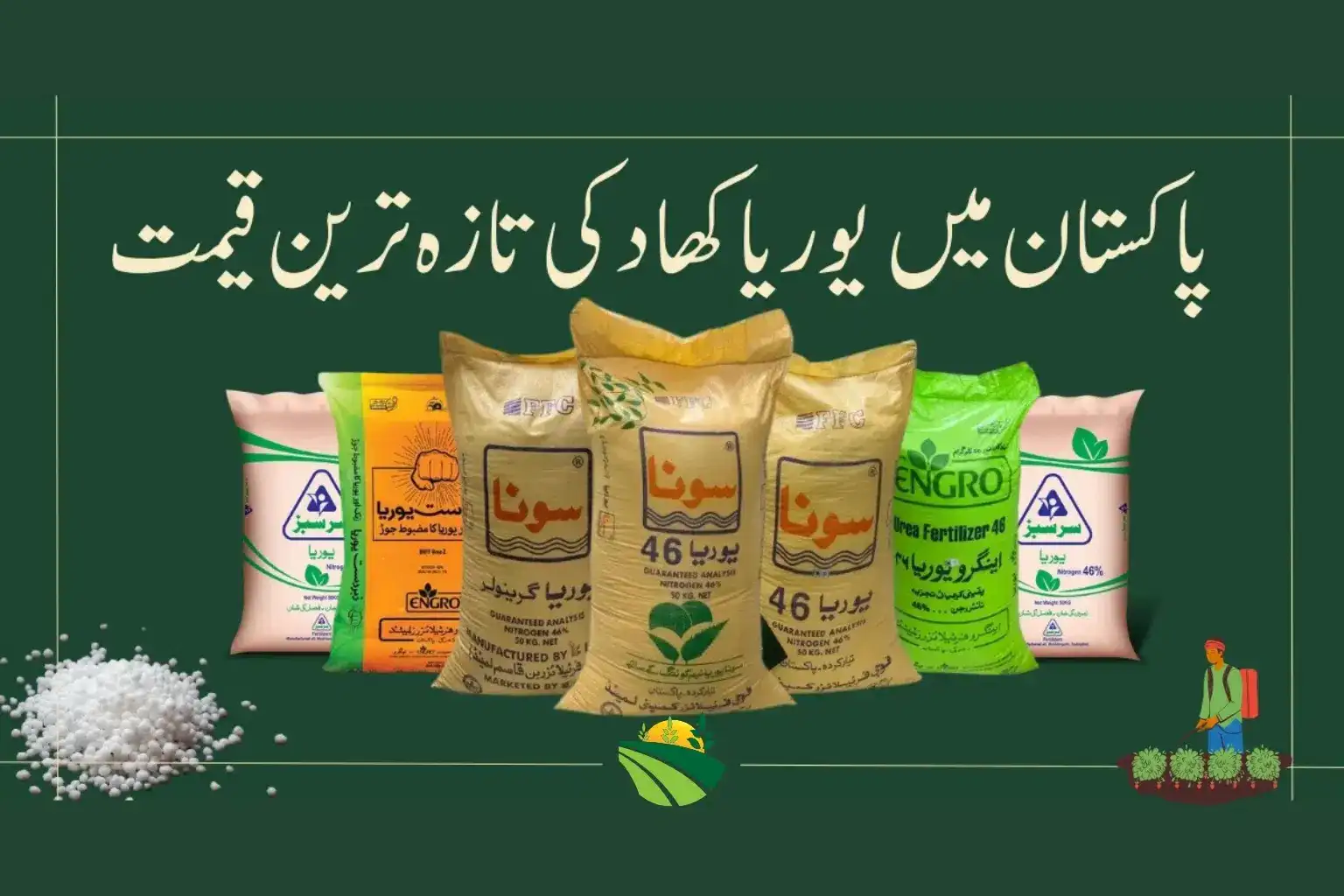
Fertilizer Price in Pakistan Today (کھاد کا ریٹ) – Urea, DAP, NP & Potash Rates
Complete daily benchmark rates for agricultural fertilizers across Punjab, Sindh, KPK, and Balochistan dealer markets (FFC Sona, Engro, Sarsabz, Agritech & imported stocks).
⚡ Today Urea Fertilizer Prices in Pakistan (50 KG Bag)
| Urea Brand & Manufacturer | Today Price (PKR) |
|---|---|
| Sona Urea (Prilled)Fauji Fertilizer Company (FFC) • 46% Nitrogen • 50 KG | Rs. 4,580 – 4,850Ex-dealer / Punjab-Sindh |
| Sona Urea (Granular)FFC Granular Heavy Granules • 46% Nitrogen • 50 KG | Rs. 4,680 – 4,920Extended release |
| Engro Urea (Prilled)Engro Fertilizers Limited • 46% Nitrogen • 50 KG | Rs. 4,550 – 4,800Premium prills |
| Sarsabz UreaFatima Fertilizer Group • 46% N • 50 KG | Rs. 4,500 – 4,750Certified dealer price |
| Tara Urea (Agritech)Agritech Limited • 50 KG Bag | Rs. 4,450 – 4,680Retail benchmark |
| Imported / NFML UreaNational Fertilizer Marketing Ltd • 50 KG Bag | Rs. 4,400 – 4,650Govt subsidized quota |
🌾 Today DAP Fertilizer Prices in Pakistan (Di-Ammonium Phosphate 50 KG)
| DAP Brand & Grade | Today Price (PKR) |
|---|---|
| Sona DAPFFC / FFBL • 18% N, 46% P2O5 • 50 KG | Rs. 16,400 – 17,200Standard benchmark |
| Engro DAPEngro Fertilizers • Dark brown granules • 50 KG | Rs. 16,550 – 17,300Commercial market |
| Sona Boron DAPFFC Boron-Enriched DAP • 50 KG Bag | Rs. 16,800 – 17,500Micronutrient formula |
| Sarsabz DAPFatima Fertilizer • 50 KG Bag | Rs. 16,250 – 16,900Ex-plant rate |
| Moroccan / Saudi Imported DAPHigh Water Soluble Phosphate • 50 KG | Rs. 17,000 – 17,400Port & logistics included |
🧪 Nitrophos (NP) & Calcium Ammonium Nitrate (CAN Gowara) Prices
| Product & Composition | Today Price (PKR) |
|---|---|
| Sarsabz Nitrophos (NP)Fatima Fertilizer • 22% N, 20% P • 50 KG | Rs. 10,350 – 10,800Fast vegetative starter |
| Engro Nitrophos (NP Plus)Engro Fertilizers • 50 KG Bag | Rs. 10,480 – 10,950Balanced N-P |
| Sarsabz CAN (Gowara)Calcium Ammonium Nitrate • 26% N • 50 KG | Rs. 4,280 – 4,450Non-acidifying nitrogen |
| Pakchem CAN (Gowara)Standard Gowara • 26% N • 50 KG | Rs. 4,220 – 4,380Mandi retail price |
🌿 Potash Fertilizer Prices (SOP & MOP 50 KG Bags)
| Potash Type & Purity | Today Price (PKR) |
|---|---|
| Sulphate of Potash (SOP)Engro / FFC SOP • 50% K2O, 18% S • 50 KG | Rs. 15,200 – 15,800Chloride-free premium |
| Korn-Kali Germany SOPImported Potassium + Magnesium • 50 KG | Rs. 12,450European origin |
| Muriate of Potash (MOP)Potassium Chloride 60% K2O • 50 KG | Rs. 11,800 – 12,500Field crop application |
| Sangral Soluble SOPAltiga Agri / SQM Drip & Foliar • 25 KG | Rs. 13,655High dissolution grade |
💧 Micronutrients, Zinc & Humic Acid Prices
| Product & Technical Grade | Today Price (PKR) |
|---|---|
| FMC Sixer Zinc (33%)High bio-availability Zinc • 3 KG Pack | Rs. 1,395Paddy & maize standard |
| Sona Zinc (33% Monohydrate)FFC Chelated/Granular Zinc • 3 KG Pack | Rs. 5,630Ex-dealer price |
| Apower Humic Acid (85% Potassium Humate)Soil conditioner & root stimulator • 5 KG | Rs. 6,500Water soluble |
| Syngenta Enrich Foliar TonicLiquid Micro-nutrient Booster • 1 Litre Bottle | Rs. 2,150Syngenta Crop Protection |
| Advancer NPK 20:20:20Balanced Foliar Nutrition • 1 KG Pack | Rs. 5,950Vegetative & fruiting boost |
📐 How Fertilizer Prices Are Formulated in Pakistan: The 4 Core Macro Drivers
Fertilizer is the single largest variable cash expenditure for Pakistani agricultural producers after tube-well energy costs (such as tracking daily diesel prices in Pakistan or converting farm borings to solar VFD tube wells). Unlike local grains whose floor prices are determined by provincial procurement targets, synthetic chemical fertilizer pricing is determined by a complex interaction of international commodity benchmarks, natural gas feed gas tariffs, and currency valuations:
- Natural Gas Feed Gas & Fuel Gas Tariffs (Urea Benchmark): Urea ($NH_2CONH_2$) requires methane ($CH_4$) both as a primary raw material feedstock to extract nitrogen via the Haber-Bosch synthesis process and as fuel to power high-pressure compression plants. In Pakistan, domestic fertilizer plants operate on two distinct gas tariff systems:
- Indigenous Mari Network Gas: Plants connected to the dedicated Mari gas field (such as FFC Goth Machhi and Engro Daharki) historically received gas at sovereign concessionary rates, stabilizing baseline dealer transfer prices.
- SNGPL / SSGC RLNG Network: Plants operating in northern Punjab on imported Re-gasified Liquefied Natural Gas (RLNG) incur substantially higher production costs. When the federal government revises feed gas prices upward to clear circular energy debt, local Urea bag prices inevitably rise by Rs. 150 to Rs. 400 per bag.
- International Phosphoric Acid & Rock Phosphate Benchmarks (DAP Driver): Pakistan is not self-sufficient in raw phosphate. Fauji Fertilizer Bin Qasim (FFBL) manufactures local DAP using imported rock phosphate and liquid phosphoric acid ($H_3PO_4$) shipped in specialized chemical tankers primarily from the Office Chérifien des Phosphates (OCP) in Morocco and SABIC in Saudi Arabia. Therefore, international phosphate export quotes (FOB Tampa or FOB Morocco in US Dollars) directly set Pakistani DAP baseline wholesale costs.
- USD to Pakistani Rupee (USD/PKR) Exchange Parity: Because over 70% of the finished phosphate and 100% of the specialized potash (SOP/MOP) consumed across Pakistani farms is imported, every single Rupee of currency depreciation instantly inflates port clearance costs at Karachi and Port Qasim, pushing retail bag prices upward.
- Seasonal Demand Spikes & Middleman Cartelization: During the narrow 6-week window of peak Rabi wheat sowing (when farmers track daily Wheat Prices in Pakistan to balance bag costs) and the peak Kharif rice tillering window (tracked alongside Munji Paddy Rates), localized artificial hoarding by regional dealer cartels frequently creates supply bottlenecks, forcing cash-strapped smallholder farmers to purchase bags at a Rs. 200 to Rs. 600 premium above company-notified Maximum Retail Prices (MRP).
🏭 Major Fertilizer Manufacturers in Pakistan: FFC vs. Engro vs. Fatima
Choosing the correct fertilizer brand is not just about price; it directly influences granule dissolution speed, soil salinity impact, and mechanical spreading uniformity:
1. Fauji Fertilizer Company (FFC – Sona Brand)
Market Share: ~50% of national Urea sales.
Flagship Products: Sona Urea (Prilled), Sona Urea (Granular), Sona DAP, Sona Boron DAP, Sona Zinc.
Agronomic Advantages: FFC operates state-of-the-art production complexes in Goth Machhi and Mirpur Mathelo. Sona Urea is celebrated for its uniform pellet geometry and minimal biuret content (<1%), preventing seedling chemical burn during germination. Their Granular Urea variant provides delayed nitrogen release, minimizing volatilization losses in warm weather.
2. Engro Fertilizers Limited
Market Share: ~32% of national production.
Flagship Products: Engro Urea, Engro DAP, Engro Zarkhez (compound NPK), Engro Zorawar.
Agronomic Advantages: Operating the iconic Enven plant in Daharki (one of the single largest single-train ammonia-urea plants in the world), Engro is renowned for high chemical purity and specialized multi-nutrient blends. Their Zarkhez series integrates macro and micronutrients into individual granules, ensuring balanced nutrition for high-value horticultural crops.
3. Fatima Fertilizer Group (Sarsabz Brand)
Market Share: Domestic leader in specialized Nitrophos and CAN.
Flagship Products: Sarsabz CAN (Calcium Ammonium Nitrate – 26% N), Sarsabz Nitrophos (NP 22:20), Sarsabz Urea.
Agronomic Advantages: Fatima’s specialized complexes in Sadiqabad and Sheikhupura supply non-acidifying nitrogen. Their flagship CAN (Gowara) combines nitrate nitrogen with 10% soluble calcium, making it the undisputed gold standard for Pakistani soils with elevated electrical conductivity (EC) and salinity.
4. Agritech Limited & Pakchem (Tara Brand)
Market Share: Regional stronghold across northern Punjab and KPK.
Flagship Products: Tara Urea, Tara CAN, Single Super Phosphate (SSP).
Agronomic Advantages: Operating plants in Mianwali and Haripur, Agritech delivers dependable utility-grade nitrogen and phosphorus formulations that provide economical alternatives for budget-conscious farming operations.
🧪 Nitrogen, Phosphorus & Potassium: Understanding the NPK Chemistry for Pakistani Soils
Most agricultural soils across the Indus basin are inherently alkaline (pH ranging from 7.8 to 8.5) and critically deficient in organic matter (<1%). Understanding chemical behavior prevents costly nutrient lockup:
- Urea (46% Nitrogen): When broadcast on moist, warm, alkaline soil, Urea rapidly hydrolyzes into ammonium carbonate by the soil enzyme urease. If not immediately incorporated by tillage or flood irrigation, up to 30% of the nitrogen can evaporate into the atmosphere as gaseous ammonia ($NH_3$). Always irrigate within 4 to 6 hours of application.
- CAN / Calcium Ammonium Nitrate (26% Nitrogen): Contains 50% immediately available Nitrate ($NO_3^-$) and 50% Ammonium ($NH_4^+$) along with neutral calcium carbonate. Unlike Urea, CAN does not volatilize easily in warm temperatures and does not cause soil acidification, making it superior for citrus orchards, vegetables, and saline soil patches.
- DAP / Di-Ammonium Phosphate (18% N : 46% P₂O₅): Phosphorus has near-zero mobility in soil (moving less than 2 to 3 millimeters from the granule). Broadcasting DAP on top of dry soil is a complete waste of money; it must be drilled or band-placed at seed depth (2 to 3 inches below the surface) so seedling taproots can physically reach the phosphate ions before soil calcium locks them into insoluble tricalcium phosphate.
- Nitrophos / NP (22% N : 20% P₂O₅): Formulated with half nitrate nitrogen and half ammoniacal nitrogen alongside water-soluble phosphate. NP dissolves much faster than DAP, making it the ideal fertilizer for split top-dressing during the second and third irrigations of wheat and maize.
- SOP vs. MOP (Potash Selection):
• SOP (Sulphate of Potash – $K_2SO_4$): 50% Potash with 18% Sulfur. Zero chloride. Safe for all Pakistani soils and essential for cash crops (potato, sugarcane, mango, cotton, onion).
• MOP (Muriate of Potash – $KCl$): 60% Potash with 47% Chloride. Cheaper, but chloride ions exacerbate soil salinity. Avoid using MOP on clay soils or tube-well brackish water fields.
📜 Government Fertilizer Subsidies & Kissan Card Verification Process
To protect farming margins against soaring global import costs, the Government of Punjab, Sindh Agriculture Department, and the Federal Ministry of National Food Security operate targeted direct cash subsidy programs:
How to Claim the 8070 SMS Fertilizer Subsidy Token:
- Locate the Security Voucher: Every subsidized bag of DAP, Potash, or Nitrophos carries a scratch-card voucher stitched inside the top seam of the inner plastic liner.
- Scratch the Protective Coating: Reveal the unique 16-digit alphanumeric serial token.
- Format Your SMS: Type:
TOKEN_NUMBER[Space]CNIC_NUMBER(e.g.,1234567890123456 3520112345671). - Send to Official Shortcode: Send the SMS to 8070 from your Kissan Card-registered mobile phone SIM.
- Collect Subsidy Cash: Upon real-time verification, a confirmation SMS with a Transaction ID (TrxID) is received. Collect the cash subsidy (ranging from Rs. 1,000 to Rs. 2,500 per bag depending on current fiscal quotas) from any authorized HBL Konnect, Omni, or designated bank agent biometrically.
🛡️ 7 Golden Field Tests to Avoid Fake / Adulterated Fertilizer (دو نمبری کھاد کی پہچان)
Due to high price differentials, unscrupulous black-market syndicates frequently blend authentic fertilizer with crushed quarry stone, river sand, red clay, marble powder, and industrial salt. Protect your investment with these 7 quick field tests:
Field Inspection Protocol for Genuine Bags:
- The Urea Rapid Water & Ice-Chill Test: Drop 2 tablespoons of Urea into a glass of clean room-temperature water. Real Urea dissolves within 60 to 90 seconds without leaving any gritty white residue. Furthermore, genuine endothermic dissolution causes the glass water temperature to drop dramatically (it will feel ice-cold to the touch). If the water stays warm or chalky sediment settles at the bottom, the bag is adulterated with marble powder or salt.
- The Hot Iron Plate Burn Test (Urea): Place a few granules of Urea on a red-hot iron spoon or tava over a gas flame. Real Urea melts immediately, boils, releases a strong ammonia vapor, and completely disappears leaving zero ash or residue. Fake urea leaves a hard, white crust or burnt gravel.
- The DAP Slaked Lime (Chuna) Ammonia Test: Take a small pinch of DAP granules and rub it vigorously between your palms with a tiny drop of slaked lime (paan wala chuna). Genuine DAP undergoes immediate chemical reaction and releases a pungent, eye-watering ammonia gas smell. If there is no smell, the bag contains dyed crushed stone.
- The DAP Granule Brittleness Test: Genuine DAP granules are tough, uniform, and resist fingernail pressure. Adulterated clay pellets crumble easily into brown dust when squeezed between two fingers.
- Check Machine Lock-Stitching: Original manufacturer bags (FFC, Engro, Fatima) are factory-stitched using specialized high-tension single-line automated lock-stitching with braided nylon thread. Tampered or refilled counterfeit bags invariably show uneven manual double-holes or loose jute stitching.
- Scan QR Codes & Check Batch Printing: Genuine bags feature high-resolution dot-matrix inkjet printing on the side gusset detailing Batch Number, Manufacturing Date, Expiry Date, and Bag Gross Weight (50.2 kg including bag). Fake bags have smudged screen-printed text that rubs off with moisture.
- Insist on Authorized Dealer Tax Invoices: Never buy fertilizer from roadside middlemen or unverified tractors selling at steep discounts. Always demand a printed receipt bearing the authorized dealer’s license number and national tax number (NTN).
🚜 Recommended Fertilizer Application per Acre for Major Pakistani Crops
To maximize yield (Maunds per Acre) and prevent wasteful over-application, agricultural extension departments recommend the following balanced nutrition guidelines for medium-fertility soils:
| Crop | DAP (Sowing) | Urea / CAN (Irrigations) | Potash & Zinc |
|---|---|---|---|
| Wheat (گندم)Target: 50+ Maunds • See Wheat Mandi Rates | 1 to 1.5 Bags at drill sowing | 2 Bags Urea (split across 1st & 2nd watering) | 0.5 Bag SOP + 3 KG Zinc 33% at 1st watering |
| Cotton (کپاس)Target: 35+ Maunds | 1 Bag DAP + 1 Bag SOP at seedbed prep | 3 Bags Urea / CAN (split every 15–20 days) | Boron foliar spray at squaring & boll formation |
| Rice / Basmati (دھان / منجی)Target: 45+ Maunds • See Munji (Dhan) Rates | 1 Bag DAP or 1.5 Bags NP at puddling | 2 Bags Urea (split at 20 & 40 days after transplant) | 5 KG Zinc Sulphate 33% at 15–20 days (Mandatory) |
| Maize / Corn (مکئی)Spring & Autumn Hybrid | 1.5 Bags DAP at sowing | 3 Bags Urea or 4 Bags CAN (split during tasseling) | 1 Bag SOP + 3 KG Zinc at 4-leaf stage |
| Sugarcane (کماد)Target: 800+ Maunds • See Sugar Prices Today | 2 Bags DAP at trench planting | 4 to 5 Bags Urea / CAN (split through tillering) | 2 Bags SOP (split at 60 and 120 days) |
❓ Frequently Asked Questions (Fertilizer Buying & Rates FAQs)
What is the price of a 50 kg Urea bag in Pakistan today?
As of November 2026, the official dealer transfer price of a standard 50 kg Urea bag ranges between Rs. 4,450 to Rs. 4,750. Fauji Fertilizer Sona Urea trades at approximately Rs. 4,580 to Rs. 4,680, Engro Urea at Rs. 4,520, and Sarsabz Urea at Rs. 4,490 per bag. In remote districts during peak sowing season, local retail rates may slightly fluctuate based on transportation costs.
What is the current DAP fertilizer price in Pakistan?
A 50 kg bag of Sona DAP (Fauji Fertilizer) currently trades between Rs. 16,400 to Rs. 16,800. Engro DAP is priced at around Rs. 16,550, while imported Moroccan or Saudi DAP stocks range between Rs. 17,000 to Rs. 17,200 per bag depending on port handling and international phosphoric acid benchmarks.
Why is DAP fertilizer so much more expensive than Urea?
Urea is manufactured domestically using local natural gas reserves (~85% self-sufficiency), whereas Pakistan imports over 70% of its raw phosphate rock and phosphoric acid from Morocco and Saudi Arabia. Higher international dollar-denominated phosphate prices and currency devaluation directly increase DAP production and import costs.
What is the difference between Prilled Urea and Granular Urea?
Prilled Urea consists of small, round, smooth beads that dissolve very rapidly in water, making it ideal for quick absorption during flood irrigation. Granular Urea has larger, harder, and moisture-resistant granules that dissolve slower, providing sustained nitrogen release and reducing volatilization losses in hot, humid weather.
When is Calcium Ammonium Nitrate (CAN Gowara) preferred over Urea?
CAN (26% Nitrogen) contains neutral calcium carbonate and releases nitrogen in nitrate and ammonium forms without acidifying soil. It is superior to Urea on alkaline, sodic, and saline soils prevalent across the Indus basin, and does not evaporate as ammonia gas during warm temperatures.
How can farmers verify authentic fertilizer bags and claim subsidies?
Scratch the protective coating on the voucher stitched inside genuine bags to reveal the 16-digit security token. Send an SMS with ‘TOKEN_NUMBER CNIC’ to 8070 from your Kissan Card-registered mobile phone to verify bag authenticity and claim direct cash subsidies biometrically through HBL Konnect agents.
Which potash fertilizer is better for Pakistani soils: SOP or MOP?
SOP (Sulphate of Potash, 50% K2O) is the recommended choice because it is chloride-free and supplies 18% sulfur. MOP (Muriate of Potash, 60% K2O) contains high chloride levels (47%), which can increase soil salinity and harm chloride-sensitive crops such as potatoes, fruits, tobacco, and vegetables.